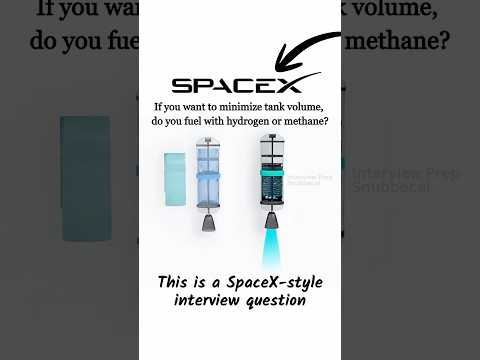
If you want to minimize tank volume, do you fuel your rocket with hydrogen or methane? #rockets
3-Second Blueprint (English)
- Liquid hydrogen gives ~20% higher Isp (~450 s vs. 370 s for methane), cutting propellant mass by ~33% for a 6 km/s delta-V stage.
- Liquid methane is 6x denser than LH2 (420 vs. 71 kg/m³), yielding 2.3x higher bulk propellant density once liquid oxygen is added.
- Density outweighs mass savings: a hydrolox stage requires ~60% more tank volume than methalox, making methane optimal for tight stages.
Tsiolkovsky EquationSpecific Impulse (Isp)Bulk Propellant DensityMethalox Propulsion
3-Sekunden-Fazit (Deutsch)
- Flüssigwasserstoff bietet ~20 % mehr Isp (~450 s vs. 370 s bei Methan) und spart bei 6 km/s Delta-V rund ein Drittel Treibstoffmasse.
- Flüssigmethan ist 6-mal dichter als LH2 (420 vs. 71 kg/m³) und erreicht samt Flüssigsauerstoff die 2,3-fache Gesamttreibstoffdichte.
- Die Dichte überwiegt die Massenersparnis: Hydrolox benötigt ~60 % mehr Tankvolumen als Methalox, weshalb Methan bei Platzmangel siegt.
Ziolkowski-GleichungSpezifischer Impuls (Isp)TreibstoffdichteMethalox-Antrieb
Note / Hinweis: Blueprints are AI-generated educational summaries (0% Politics · 0% Religion · 0% Brainrot) and do not constitute medical, legal, or financial advice. / KI-generierte Zusammenfassung zu Bildungszwecken – ersetzt keine medizinische, rechtliche oder finanzielle Fachberatung.