Gate Control Theory of Pain
3-Second Blueprint (English)
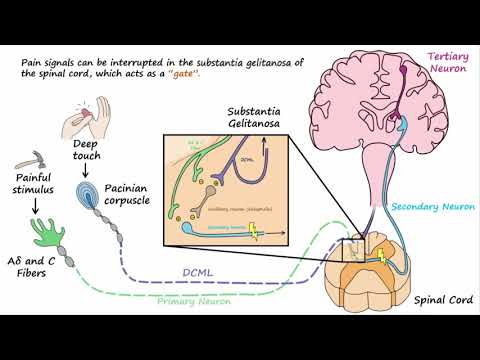
- Nociceptive A-delta and C fibers release glutamate and substance P in the substantia gelatinosa to excite spinothalamic pain pathways.
- Rubbing an injury stimulates dermal Pacinian corpuscles and ipsilateral DCML touch fibers, recruiting spinal inhibitory interneurons.
- Released enkephalins bind opioid receptors to close presynaptic Ca2+ channels and open postsynaptic K+ channels, blunting pain signals.
Substantia GelatinosaSpinothalamic TractDCML Touch PathwayEnkephalin Modulation
3-Sekunden-Fazit (Deutsch)
- Nozizeptive A-delta- und C-Fasern schütten in der Substantia gelatinosa Glutamat und Substanz P aus und aktivieren den Vorderseitenstrang.
- Reiben der Schmerzstelle reizt Vater-Pacini-Körperchen und die DCML-Tastbahn, wodurch hemmende Interneurone im Rückenmark aktiviert werden.
- Freigesetztes Enkephalin schließt präsynaptische Ca2+-Kanäle und öffnet postsynaptische K+-Kanäle, was die Schmerzweiterleitung dämpft.
Substantia gelatinosaTractus spinothalamicusDCML-HinterstrangbahnEnkephalin-Hemmung
Note / Hinweis: Blueprints are AI-generated educational summaries (0% Politics · 0% Religion · 0% Brainrot) and do not constitute medical, legal, or financial advice. / KI-generierte Zusammenfassung zu Bildungszwecken – ersetzt keine medizinische, rechtliche oder finanzielle Fachberatung.