Olfactory System: Anatomy and Physiology, Pathways, Animation.
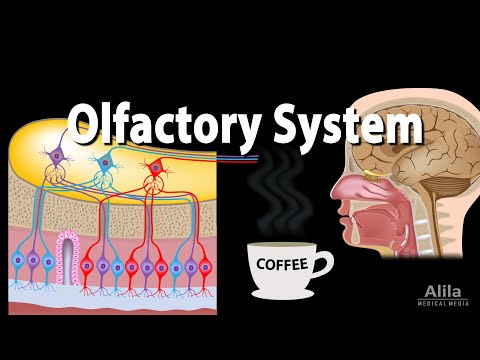
3-Second Blueprint (English)
- Mucus-dissolved odorants bind ~400 G-protein receptors combinatorially on olfactory cilia to trigger action potentials.
- Cranial nerve I axons converge by receptor type onto bulb glomeruli, synapsing on mitral and tufted cells under feedback.
- Epithelial stem cells continually replace olfactory neurons, whereas total loss or neurodegeneration causes anosmia.
Combinatorial Odor CodingG-Protein Odorant ReceptorsOlfactory Bulb GlomeruliMitral & Tufted CellsOlfactory NeurogenesisAnosmia Mechanisms
3-Sekunden-Fazit (Deutsch)
- Im Schleim gelöste Duftstoffe binden kombinatorisch an rund 400 G-Protein-Rezeptoren auf Riechzilien und lösen Signale aus.
- Axone des I. Hirnnervs bündeln sich nach Rezeptortyp in Glomeruli und verschalten dort auf Mitral- und Büschelzellen.
- Stammzellen im Riechepithel erneuern Riechneuronen laufend, während Komplettverlust oder Neurodegeneration Anosmie bewirkt.
Kombinatorische DuftkodierungG-Protein-GeruchsrezeptorenRiechkolben-GlomeruliMitral- & BüschelzellenOlfaktorische NeurogeneseAnosmie-Mechanismen
Note / Hinweis: Blueprints are AI-generated educational summaries and do not constitute medical, legal, or financial advice. / KI-generierte Zusammenfassung zu Bildungszwecken – ersetzt keine medizinische, rechtliche oder finanzielle Fachberatung.